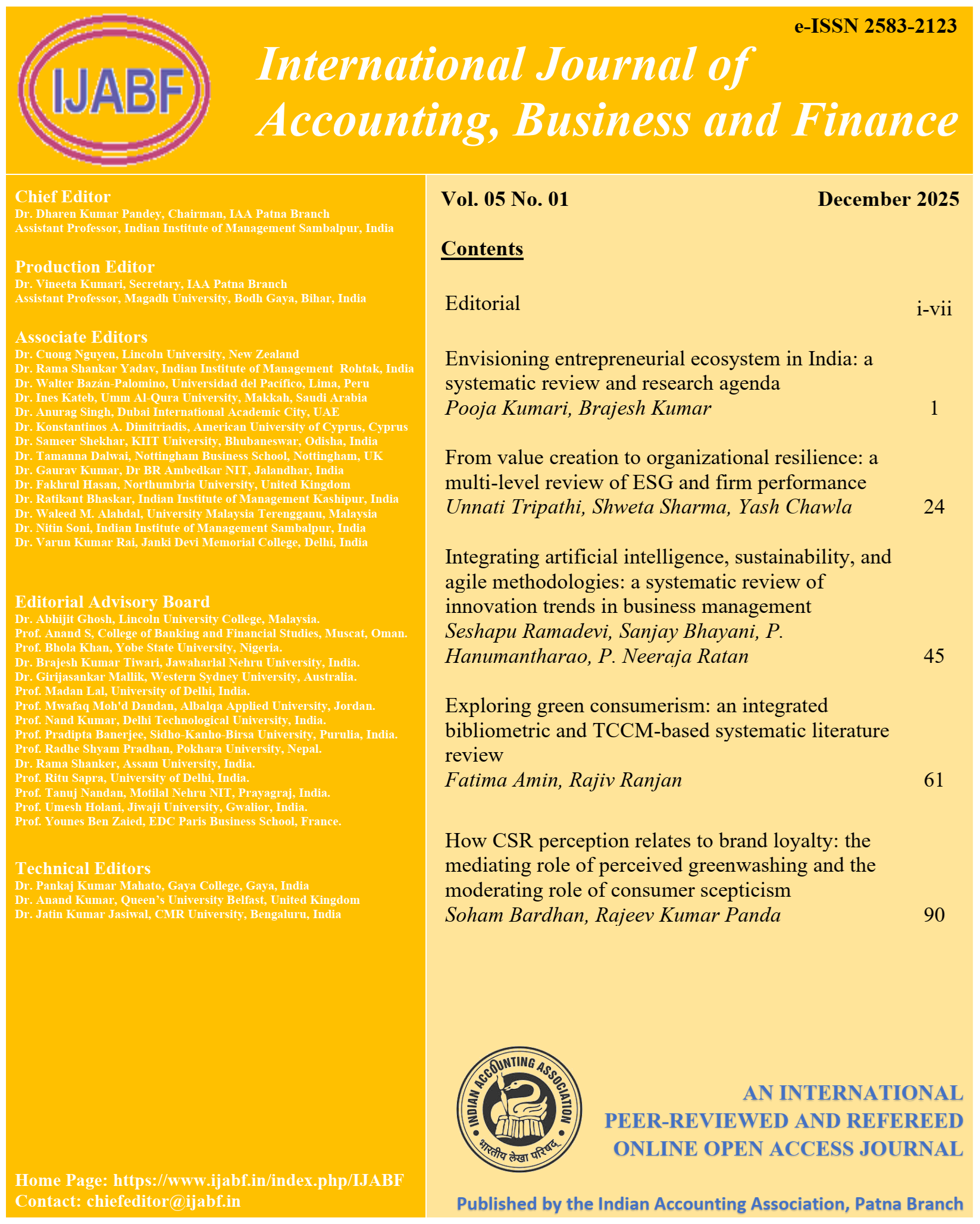
Integrating artificial intelligence, sustainability, and agile methodologies: a systematic review of innovation trends in business management
DOI:
https://doi.org/10.55429/ijabf.v5i1.264Keywords:
Innovation trends, business management, digital transformation, artificial intelligence, sustainability, agile methodologies, dynamic capabilities, systematic reviewAbstract
In a business environment shaped by digital acceleration, sustainability pressures, and volatile market conditions, innovation in management has become a multidimensional organizational capability rather than a narrow product-development activity. This paper presents a systematic review of contemporary literature on three interconnected themes in modern business management: digital transformation driven by artificial intelligence, sustainability-oriented innovation, and agile methodologies. Unlike an empirical field study, the paper relies exclusively on secondary sources, including peer-reviewed journal articles and high-quality industry reports. The review identifies a central gap in the literature: although these themes are widely discussed, they are often examined in isolation, leaving a limited understanding of how they jointly influence organizational resilience, adaptability, and long-term value creation. To address this gap, the study synthesizes existing scholarship through a thematic and integrative lens and proposes a conceptual framework grounded in dynamic capabilities and the technology–organization–environment perspective. The analysis shows that AI strengthens analytical and operational capabilities, that sustainability increasingly functions as a strategic rather than symbolic imperative, and that agile methods improve responsiveness when supported by an appropriate culture and governance. The review also argues that the practical benefits of these innovation trends depend on organizational readiness, leadership alignment, and the ability to balance experimentation with strategic coherence. The paper contributes by offering a more structured understanding of contemporary innovation trends and outlining future directions, including generative AI, metaverse-enabled business models, and quantum-informed strategic decision-making environments.
References
Agrawal, A., Gans, J., & Goldfarb, A. (2019). Prediction, Judgment, and Complexity. In The Economics of Artificial Intelligence (pp. 89–114). University of Chicago Press. https://doi.org/10.7208/chicago/9780226613475.003.0003 DOI: https://doi.org/10.7208/chicago/9780226613475.003.0003
Armbrust, M., Fox, A., Griffith, R., Joseph, A. D., Katz, R., Konwinski, A., Lee, G., Patterson, D., Rabkin, A., Stoica, I., & Zaharia, M. (2010). A view of cloud computing. Communications of the ACM, 53(4), 50–58. https://doi.org/10.1145/1721654.1721672 DOI: https://doi.org/10.1145/1721654.1721672
Arntz, M., Gregory, T., & Zierahn, U. (2016). The Risk of Automation for Jobs in OECD Countries. https://doi.org/10.1787/5jlz9h56dvq7-en DOI: https://doi.org/10.1787/5jlz9h56dvq7-en
Bansal, P., & Roth, K. (2000). Why companies go green: A model of ecological responsiveness. Academy of Management Journal, 43(4), 717–736. https://doi.org/10.2307/1556363 DOI: https://doi.org/10.2307/1556363
Baryannis, G., Validi, S., Dani, S., & Antoniou, G. (2019). Supply chain risk management and artificial intelligence: state of the art and future research directions. International Journal of Production Research, 57(7), 2179–2202. https://doi.org/10.1080/00207543.2018.1530476 DOI: https://doi.org/10.1080/00207543.2018.1530476
Bhattacharya, C. B., Sen, S., & Korschun, D. (2008). Using corporate social responsibility to win the war for talent. MIT Sloan Management Review, 49(2). https://sloanreview.mit.edu/article/using-corporate-social-responsibility-to-win-the-war-for-talent/
Binns, R. (2018). Fairness in Machine Learning: Lessons from Political Philosophy. In S. A. Friedler & C. Wilson (Eds.), Proceedings of the 1st Conference on Fairness, Accountability and Transparency (Vol. 81, pp. 149–159). PMLR. https://proceedings.mlr.press/v81/binns18a.html
Brynjolfsson, E., & McAfee, A. (2014). The second machine age: Work, progress, and prosperity in a time of brilliant technologies (Vol. 236). WW Norton Company.
Čambalíková, A., & Richnák, P. (2021). Innovations and innovative potential in the context of new trends in business management in Slovakia. Innovations, 9(3), 89–92.
Carroll, A. B. (1999). Corporate Social Responsibility. Business & Society, 38(3), 268–295. https://doi.org/10.1177/000765039903800303 DOI: https://doi.org/10.1177/000765039903800303
Castro, L. M., Montoro-Sanchez, A., & Ortiz-De-Urbina-Criado, M. (2011). Innovation in services industries: current and future trends. The Service Industries Journal, 31(1), 7–20. https://doi.org/10.1080/02642069.2010.485196 DOI: https://doi.org/10.1080/02642069.2010.485196
Chaves Correa, F., & Öge, K. (2025). Carbon Disclosure and Climate Change Mitigation in the European Union: Diffusion and Dominance of Transparency Frames. JCMS: Journal of Common Market Studies. https://doi.org/10.1111/jcms.70079 DOI: https://doi.org/10.1111/jcms.70079
Chen, H., Chiang, R. H. L., & Storey, V. C. (2012). Business Intelligence and Analytics: From Big Data to Big Impact. MIS Quarterly, 36(4), 1165–1188. https://doi.org/10.2307/41703503 DOI: https://doi.org/10.2307/41703503
Chesbrough, H. (2007). Business model innovation: it’s not just about technology anymore. Strategy & Leadership, 35(6), 12–17. https://doi.org/10.1108/10878570710833714 DOI: https://doi.org/10.1108/10878570710833714
Chesbrough, H. (2010). Business Model Innovation: Opportunities and Barriers. Long Range Planning, 43(2–3), 354–363. https://doi.org/10.1016/j.lrp.2009.07.010 DOI: https://doi.org/10.1016/j.lrp.2009.07.010
Choi, T., Wallace, S. W., & Wang, Y. (2018). Big Data Analytics in Operations Management. Production and Operations Management, 27(10), 1868–1883. https://doi.org/10.1111/poms.12838 DOI: https://doi.org/10.1111/poms.12838
Chui, M., Manyika, J., & Miremadi, M. (2018). What AI can and can’t do (yet) for your business. McKinsey Quarterly, 1(97–108), 1. https://www.mckinsey.com/capabilities/quantumblack/our-insights/what-ai-can-and-cant-do-yet-for-your-business
Conforto, E. C., Salum, F., Amaral, D. C., da Silva, S. L., & de Almeida, L. F. M. (2014). Can Agile Project Management be Adopted by Industries Other than Software Development? Project Management Journal, 45(3), 21–34. https://doi.org/10.1002/pmj.21410 DOI: https://doi.org/10.1002/pmj.21410
Davenport, T. H. (2018). The AI Advantage. The MIT Press. https://doi.org/10.7551/mitpress/11781.001.0001 DOI: https://doi.org/10.7551/mitpress/11781.001.0001
Davenport, T. H., Barth, P., & Bean, R. (2012). How “big data” is different. MIT Sloan Management Review. https://sloanreview.mit.edu/article/how-big-data-is-different/
Denning, S. (2022). The age of agile: How smart companies are transforming the way work gets done. HarperCollins Leadership.
Eccles, R. G., Ioannou, I., & Serafeim, G. (2014). The Impact of Corporate Sustainability on Organizational Processes and Performance. Management Science, 60(11), 2835–2857. https://doi.org/10.1287/mnsc.2014.1984 DOI: https://doi.org/10.1287/mnsc.2014.1984
Elkington, J. (1997). Cannibals with Forks: the triple bottom line of 21st century business. Capstone Publ. Oxford. https://dn721609.ca.archive.org/0/items/BusinessMoneyBooksarchive/Cannibals%20With%20Forks%20-%20The%20Triple%20Bottom%20Line%20of%2021st%20Century%20Business.pdf
Fitzgerald, M., Kruschwitz, N., Bonnet, D., & Welch, M. (2014). Embracing digital technology: A new strategic imperative. MIT Sloan Management Review, 55(2), 1. https://sloanreview.mit.edu/projects/scholars/embracing-digital-technology/
Foss, N. J., & Saebi, T. (2017). Fifteen Years of Research on Business Model Innovation. Journal of Management, 43(1), 200–227. https://doi.org/10.1177/0149206316675927 DOI: https://doi.org/10.1177/0149206316675927
Frey, C. B., & Osborne, M. A. (2017). The future of employment: How susceptible are jobs to computerisation? Technological Forecasting and Social Change, 114, 254–280. https://doi.org/10.1016/j.techfore.2016.08.019 DOI: https://doi.org/10.1016/j.techfore.2016.08.019
Frishammar, J., Richtnér, A., Brattström, A., Magnusson, M., & Björk, J. (2019). Opportunities and challenges in the new innovation landscape: Implications for innovation auditing and innovation management. European Management Journal, 37(2), 151–164. https://doi.org/https://doi.org/10.1016/j.emj.2018.05.002 DOI: https://doi.org/10.1016/j.emj.2018.05.002
Garriga, E., & Melé, D. (2004). Corporate Social Responsibility Theories: Mapping the Territory. Journal of Business Ethics, 53(1–2), 51–71. https://doi.org/10.1023/B:BUSI.0000039399.90587.34 DOI: https://doi.org/10.1023/B:BUSI.0000039399.90587.34
Hart, S. L. (1995). A Natural-Resource-Based View of the Firm. Academy of Management Review, 20(4), 986–1014. https://doi.org/10.5465/amr.1995.9512280033 DOI: https://doi.org/10.2307/258963
Heavin, C., & Power, D. J. (2018). Challenges for digital transformation – towards a conceptual decision support guide for managers. Journal of Decision Systems, 27(sup1), 38–45. https://doi.org/10.1080/12460125.2018.1468697 DOI: https://doi.org/10.1080/12460125.2018.1468697
Hidalgo, A., & Albors, J. (2008). Innovation management techniques and tools: a review from theory and practice. R&D Management, 38(2), 113–127. https://doi.org/10.1111/j.1467-9310.2008.00503.x DOI: https://doi.org/10.1111/j.1467-9310.2008.00503.x
Highsmith, J. A. (2002). Agile software development ecosystems (Vol. 13). Addison-Wesley Professional.
Hoda, R., Salleh, N., & Grundy, J. (2018). The Rise and Evolution of Agile Software Development. IEEE Software, 35(5), 58–63. https://doi.org/10.1109/MS.2018.290111318 DOI: https://doi.org/10.1109/MS.2018.290111318
Homburg, C., Jozić, D., & Kuehnl, C. (2017). Customer experience management: toward implementing an evolving marketing concept. Journal of the Academy of Marketing Science, 45(3), 377–401. https://doi.org/10.1007/s11747-015-0460-7 DOI: https://doi.org/10.1007/s11747-015-0460-7
Horn, C., & Brem, A. (2013). Strategic directions on innovation management – a conceptual framework. Management Research Review, 36(10), 939–954. DOI: https://doi.org/10.1108/MRR-06-2012-0142
Huang, M.-H., & Rust, R. T. (2021). A strategic framework for artificial intelligence in marketing. Journal of the Academy of Marketing Science, 49(1), 30–50. https://doi.org/10.1007/s11747-020-00749-9 DOI: https://doi.org/10.1007/s11747-020-00749-9
IKEA. (2016). IKEA sustainability report FY16. https://www.ikea.com/ca/en/files/pdf/05/84/05843617/ikea_group_sustainability_report_fy16_a.pdf
Iyer, B., & Henderson, J. C. (2010). Preparing for the future: understanding the seven capabilities cloud computing. MIS Quarterly Executive, 9(2). https://aisel.aisnet.org/misqe/vol9/iss2/6/
Jin, Y., & Ji, S. (2018). Mapping hotspots and emerging trends of business model innovation under networking in Internet of Things. EURASIP Journal on Wireless Communications and Networking, 2018(1), 96. https://doi.org/10.1186/s13638-018-1115-4 DOI: https://doi.org/10.1186/s13638-018-1115-4
Jorzik, P., Klein, S. P., Kanbach, D. K., & Kraus, S. (2024). AI-driven business model innovation: A systematic review and research agenda. Journal of Business Research, 182, 114764. https://doi.org/10.1016/j.jbusres.2024.114764 DOI: https://doi.org/10.1016/j.jbusres.2024.114764
Kane, G. C., Palmer, D., Phillips, A. N., Kiron, D., & Buckley, N. (2015). Strategy, not technology, drives digital transformation. MIT Sloan Management Review. https://sloanreview.mit.edu/projects/strategy-drives-digital-transformation/
Kapferer, J.-N. (2012). The new strategic brand management: Advanced insights and strategic thinking. Kogan page publishers.
Khalatur, S., Pavlova, H., Vasilieva, L., Karamushka, D., & Danileviča, A. (2022). Innovation management as basis of digitalization trends and security of financial sector. Entrepreneurship and Sustainability Issues, 9(4), 56–76. https://doi.org/10.9770/jesi.2022.9.4(3) DOI: https://doi.org/10.9770/jesi.2022.9.4(3)
Kniberg, H., & Ivarsson, A. (2012). Scaling agile@ spotify with tribes, squads, chapters & guilds. Entry Posted November, 12. https://blog.crisp.se/2012/11/14/henrikkniberg/scaling-agile-at-spotify
Latino, M. E., De Lorenzi, M. C., Corallo, A., & Petruzzelli, A. M. (2024). The impact of metaverse for business model innovation: A review, novel insights and research directions. Technological Forecasting and Social Change, 206, 123571. https://doi.org/10.1016/j.techfore.2024.123571 DOI: https://doi.org/10.1016/j.techfore.2024.123571
LaValle, S., Lesser, E., Shockley, R., Hopkins, M. S., & Kruschwitz, N. (2010). Big data, analytics and the path from insights to value. MIT Sloan Management Review. https://sloanreview.mit.edu/article/big-data-analytics-and-the-path-from-insights-to-value/
Maklan, S., Knox, S., & Ryals, L. (2008). New Trends in Innovation and Customer Relationship Management: A Challenge for Market Researchers. International Journal of Market Research, 50(2), 221–240. https://doi.org/10.1177/147078530805000206 DOI: https://doi.org/10.1177/147078530805000206
Manifesto, A. (2001). Manifesto for agile software development. https://ai-learn.it/wp-content/uploads/2019/03/03_ManifestoofAgileSoftwareDevelopment-1.pdf
Marston, S., Li, Z., Bandyopadhyay, S., Zhang, J., & Ghalsasi, A. (2011). Cloud computing — The business perspective. Decision Support Systems, 51(1), 176–189. https://doi.org/10.1016/j.dss.2010.12.006 DOI: https://doi.org/10.1016/j.dss.2010.12.006
Mayer-Schönberger, V., & Cukier, K. (2013). Big data: A revolution that will transform how we live, work, and think. Houghton Mifflin Harcourt. DOI: https://doi.org/10.25620/e140428
Midler, C., Killen, C. P., & Kock, A. (2016). Project and Innovation Management: Bridging Contemporary Trends in Theory and Practice. Project Management Journal, 47(2), 3–7. https://doi.org/10.1002/pmj.21587 DOI: https://doi.org/10.1002/pmj.21587
Morabito, V. (2014). Trends and Challenges in Digital Business Innovation. Springer International Publishing. https://doi.org/10.1007/978-3-319-04307-4 DOI: https://doi.org/10.1007/978-3-319-04307-4
Nguyen, T., Le, C. V., Nguyen, M., Nguyen, G., Lien, T. T. H., & Nguyen, O. (2025). The organisational impact of agility: a systematic literature review. Management Review Quarterly, 75(3), 2709–2757. https://doi.org/10.1007/s11301-024-00446-9 DOI: https://doi.org/10.1007/s11301-024-00446-9
Nielsen, C. (2015). The sustainability imperative: new insights on consumer expectations. Nielsen Company New York.
Noble, S. U. (2018). Algorithms of Oppression. NYU Press. https://doi.org/10.2307/j.ctt1pwt9w5 DOI: https://doi.org/10.2307/j.ctt1pwt9w5
O’neil, C. (2017). Weapons of math destruction: How big data increases inequality and threatens democracy. Crown.
Patel, K., Shah, M., Qureshi, K. M., & Qureshi, M. R. N. (2025). A systematic review of generative AI: importance of industry and startup-centered perspectives, agentic AI, ethical considerations & challenges, and future directions. Artificial Intelligence Review, 59(1), 7. https://doi.org/10.1007/s10462-025-11435-z DOI: https://doi.org/10.1007/s10462-025-11435-z
Pisano, P., Pironti, M., & Rieple, A. (2015). Identify Innovative Business Models: Can Innovative Business Models Enable Players to React to Ongoing or Unpredictable Trends? Entrepreneurship Research Journal, 5(3). https://doi.org/10.1515/erj-2014-0032 DOI: https://doi.org/10.1515/erj-2014-0032
Porter, M. E., & Heppelmann, J. E. (2014). How smart, connected products are transforming competition. Harvard Business Review, 92(11), 64–88. https://hbr.org/2014/11/how-smart-connected-products-are-transforming-competition
Porter, M. E., & Kramer, M. R. (2006). The link between competitive advantage and corporate social responsibility. Harvard Business Review, 84(12), 78–92. https://hbr.org/2006/12/strategy-and-society-the-link-between-competitive-advantage-and-corporate-social-responsibility
Ratten, V., Ferreira, J. J., & Fernandes, C. I. (2017). Innovation management - current trends and future directions. International Journal of Innovation and Learning, 22(2), 135. https://doi.org/10.1504/IJIL.2017.085916 DOI: https://doi.org/10.1504/IJIL.2017.085916
Rigby, D. K., Sutherland, J., & Takeuchi, H. (2016). Embracing agile. Harvard Business Review, 94(5), 40–50.
Rossetto, D. E., Bernardes, R. C., Borini, F. M., & Gattaz, C. C. (2018). Structure and evolution of innovation research in the last 60 years: review and future trends in the field of business through the citations and co-citations analysis. Scientometrics, 115(3), 1329–1363. https://doi.org/10.1007/s11192-018-2709-7 DOI: https://doi.org/10.1007/s11192-018-2709-7
Salampasis, D. (2025). Preparing for the Quantum Computing Revolution. Research-Technology Management, 68(5), 69–72. https://doi.org/10.1080/08956308.2025.2532324 DOI: https://doi.org/10.1080/08956308.2025.2532324
Schneckenberg, D., Velamuri, V., & Comberg, C. (2019). The Design Logic of New Business Models: Unveiling Cognitive Foundations of Managerial Reasoning. European Management Review, 16(2), 427–447. https://doi.org/10.1111/emre.12293 DOI: https://doi.org/10.1111/emre.12293
Schwab, K. (2017). The fourth industrial revolution. Crown Currency.
Schwaber, K., & Sutherland, J. (2017). The Scrum Guide: The definitive guide to Scrum: The rules of the game. Scrum. org. October, 2, 17. https://scrumguides.org/docs/scrumguide/v2017/2017-Scrum-Guide-US.pdf
Sepúlveda-Aguirre, J. A., Garcés Giraldo, L. F., Serrano García, J., & Gómez-Molina, H. F. (2016). An approach between tools for the analysis of tendencies and business innovation management. Revista Lasallista de Investigación, 13(2), 178–187. https://doi.org/10.22507/rli.v13n2a16 DOI: https://doi.org/10.22507/rli.v13n2a16
Seuring, S., & Müller, M. (2008). From a literature review to a conceptual framework for sustainable supply chain management. Journal of Cleaner Production, 16(15), 1699–1710. https://doi.org/10.1016/j.jclepro.2008.04.020 DOI: https://doi.org/10.1016/j.jclepro.2008.04.020
Sheng, J., Amankwah‐Amoah, J., Khan, Z., & Wang, X. (2021). COVID‐19 Pandemic in the New Era of Big Data Analytics: Methodological Innovations and Future Research Directions. British Journal of Management, 32(4), 1164–1183. https://doi.org/10.1111/1467-8551.12441 DOI: https://doi.org/10.1111/1467-8551.12441
Spieth, P., Breitenmoser, P., & Röth, T. (2025). Business model innovation: Integrative review, framework, and agenda for future innovation management research. Journal of Product Innovation Management, 42(1), 166–193. https://doi.org/10.1111/jpim.12704 DOI: https://doi.org/10.1111/jpim.12704
Sutherland, J. (2014). Scrum: the art of doing twice the work in half the time. Crown Currency.
Takeuchi, H., & Nonaka, I. (1986). The new new product development game. Harvard Business Review, 64(1), 137–146. https://hbr.org/1986/01/the-new-new-product-development-game
Verhoef, P. C., Kannan, P. K., & Inman, J. J. (2015). From Multi-Channel Retailing to Omni-Channel Retailing. Journal of Retailing, 91(2), 174–181. https://doi.org/10.1016/j.jretai.2015.02.005 DOI: https://doi.org/10.1016/j.jretai.2015.02.005
VersionOne. (2020). 14th annual state of agile report. https://www.eg.bucknell.edu/~cs479/common-files/resources/versionone-state-of-agile/14th-annual-state-of-agile-report.pdf
Westerman, G., Bonnet, D., & McAfee, A. (2014). Leading digital: Turning technology into business transformation. Harvard Business Press.
Yadav, A., Gyamfi, B. A., Agozie, D. Q., Asongu, S. A., & Behera, D. K. (2026). Unveiling the Dynamics of Green Innovation on ESG Performance: The Role of Financial Distress and the Impact of the Paris Agreement. Thunderbird International Business Review, 68(3), 379–397. https://doi.org/10.1002/tie.70042 DOI: https://doi.org/10.1002/tie.70042
Downloads
Published
How to Cite
Issue
Section
License
Copyright (c) 2026 Seshapu Ramadevi, Sanjay Bhayani, P. Hanumantharao, P. Neeraja Ratan

This work is licensed under a Creative Commons Attribution-NonCommercial 4.0 International License.
This is an open-access journal. Your article will be published open-access, but you will not have to pay an APC (article processing charge) - publication is free. Your article will be published with a Creative Commons CC BY-NC 4.0 user licence, which outlines how readers can reuse your work. The licence terms may be found at https://creativecommons.org/licenses/by-nc/4.0/.




Accepted 2026-04-28
Published 2026-10-03