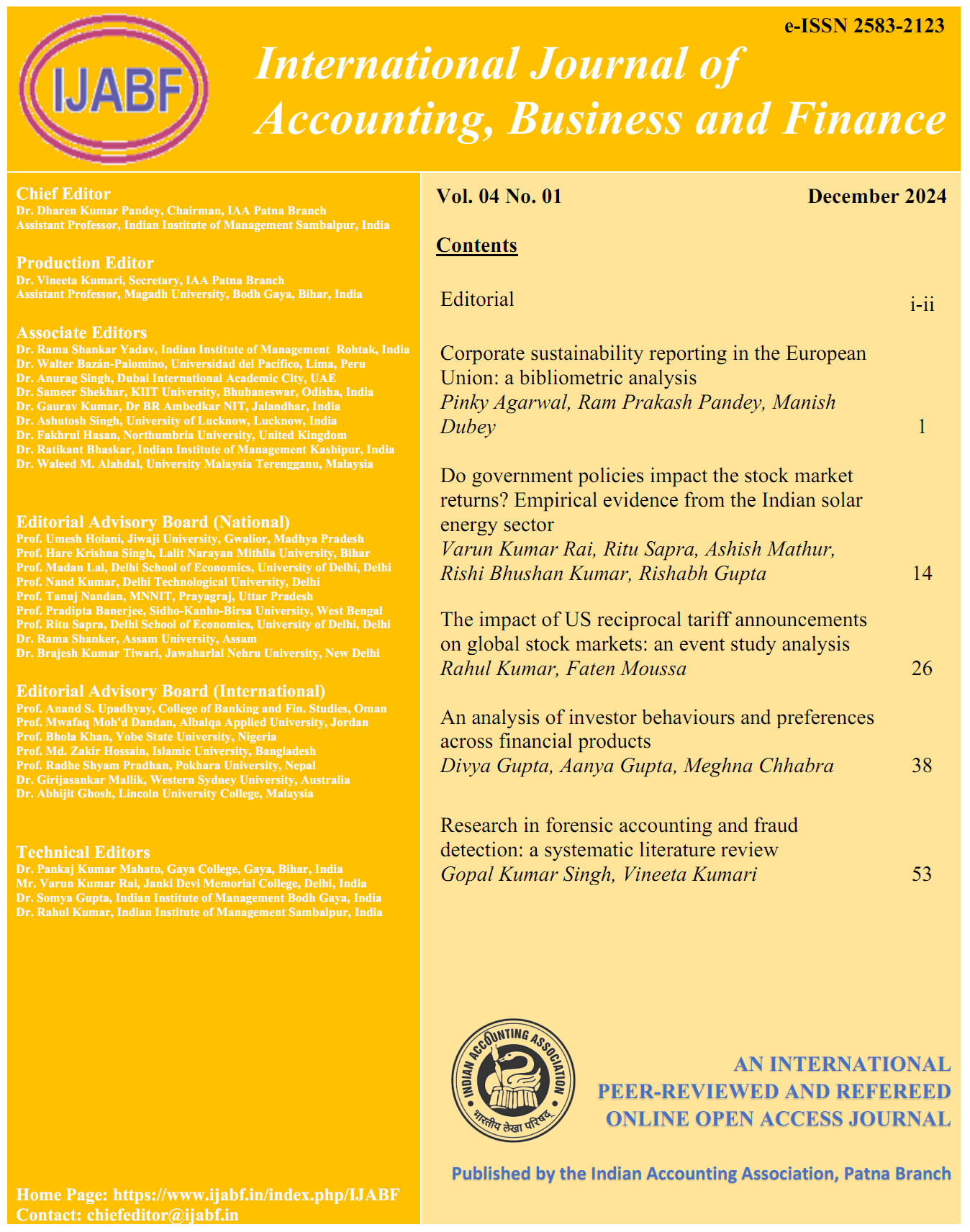
The impact of US reciprocal tariff announcements on global stock markets: an event study analysis
DOI:
https://doi.org/10.55429/ijabf.v4i1.205Keywords:
Reciprocal tariffs, event study, stock market reactions, trade policy shocks, market efficiency, emerging markets, developed marketsAbstract
This study examines the impact of the April 2025 US reciprocal tariff announcement on the stock markets of 47 countries using an event study methodology. Analyzing daily index returns across multiple event windows, we find significant negative cumulative abnormal returns (CAAR = -1.43%, p<0.01) over the [-7,+10] window, with the strongest reactions occurring within three days post-announcement. Affected countries experienced more severe declines (CAAR = -2.40%) than unaffected nations, while developed markets (-3.55%) showed greater vulnerability than emerging markets. Robustness tests confirm these findings across alternative methodologies. The results demonstrate that reciprocal tariffs, which explicitly incorporate retaliation mechanisms, generate stronger market reactions than unilateral measures, with implications for investors, policymakers, and multinational corporations navigating trade policy uncertainty.
Downloads
Published
How to Cite
Issue
Section
License
Copyright (c) 2025 Rahul Kumar, Faten Moussa

This work is licensed under a Creative Commons Attribution-NonCommercial 4.0 International License.
This is an open-access journal. Your article will be published open-access, but you will not have to pay an APC (article processing charge) - publication is free. Your article will be published with a Creative Commons CC BY-NC 4.0 user licence, which outlines how readers can reuse your work. The licence terms may be found at https://creativecommons.org/licenses/by-nc/4.0/.




Accepted 2025-11-02
Published 2025-12-31